
Oswego Lake Waterfront Homes: History and Architecture

Oregon Relo Team - Seth & Paul • October 4, 2026

Standing at Millennium Plaza, you see a slice of Oswego Lake. What you miss is how much bigger it actually is. The lake stretches beyond that first impression, lined with homes most people never see because access is limited. Some properties have no driveways. Others sit tucked behind gates or rocky bluffs that were never meant for casual viewing. If you are thinking about buying a home on the lake or looking for lake access in Lake Oswego, you need to know what is actually here.

This is not a neighborhood of cookie-cutter estates. No two homes look alike. You will find small quaint cottages next to sprawling Tudor mansions. There are 1930s International Style cabanas, English Arts and Crafts landmarks, and mid-century modern Googie structures with walls of glass. Some homes are on the National Register of Historic Places. Others have been rebuilt or expanded, but the variety is what makes this place interesting. If you love architecture, you will appreciate this tour.

The weather was gray when I shot this, but I wanted to show you what is here. If this does well, I will do a cleaner version in the spring with better light and maybe some drone footage. For now, come along as I walk the perimeter of Oswego Lake and point out the homes, the history, and the details you would otherwise miss.

Table of Contents

Oswego Lake: Waterfront Homes and Architectural Diversity

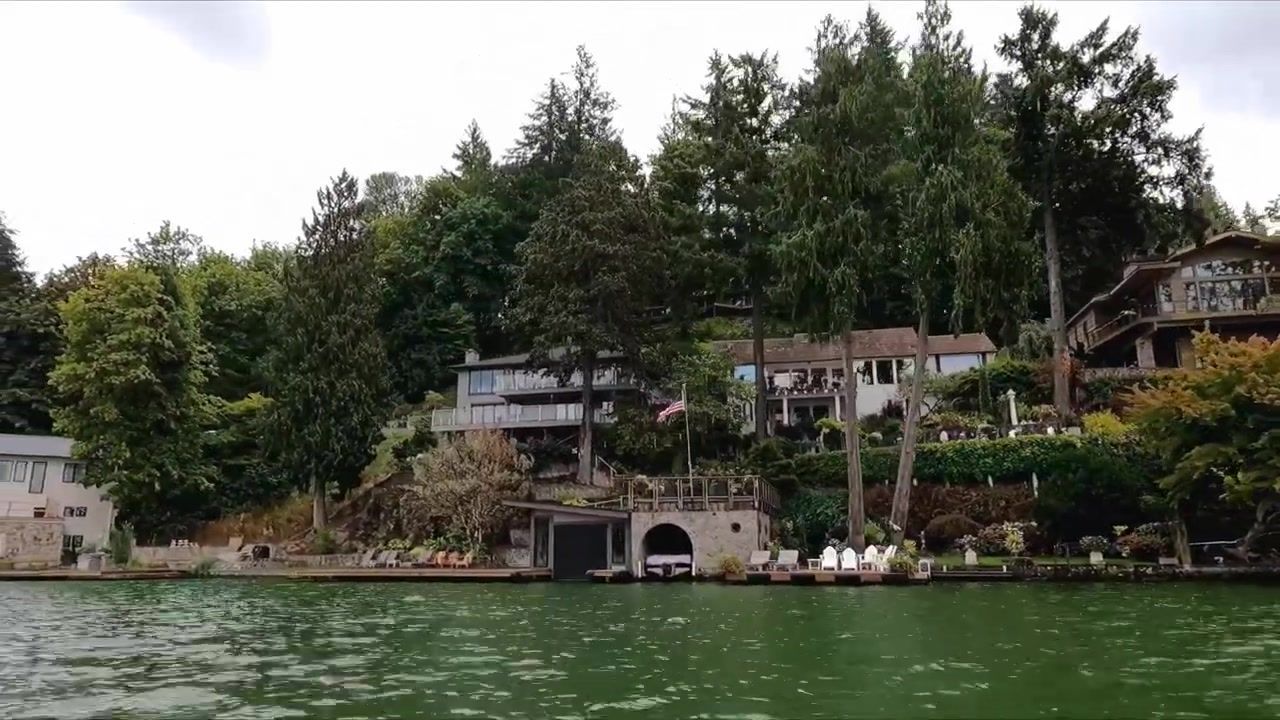
Oswego Lake is larger than it looks from the public plaza. The shoreline is lined with homes that range from historic cottages to modern additions, and many have direct lake access with boathouses, swim docks, and private waterfront. The architecture here is not uniform. You will see International Style, English Arts and Crafts, Tudor, Colonial Revival, and mid-century modern Googie. Many of these homes were built between the 1920s and 1950s, and some are designated historic landmarks. If you are considering a home on the lake, you need to understand that historic preservation restrictions may apply to certain properties. That means you might not be able to replace original windows or alter the exterior without approval.

The Original Lakewood Cabanas

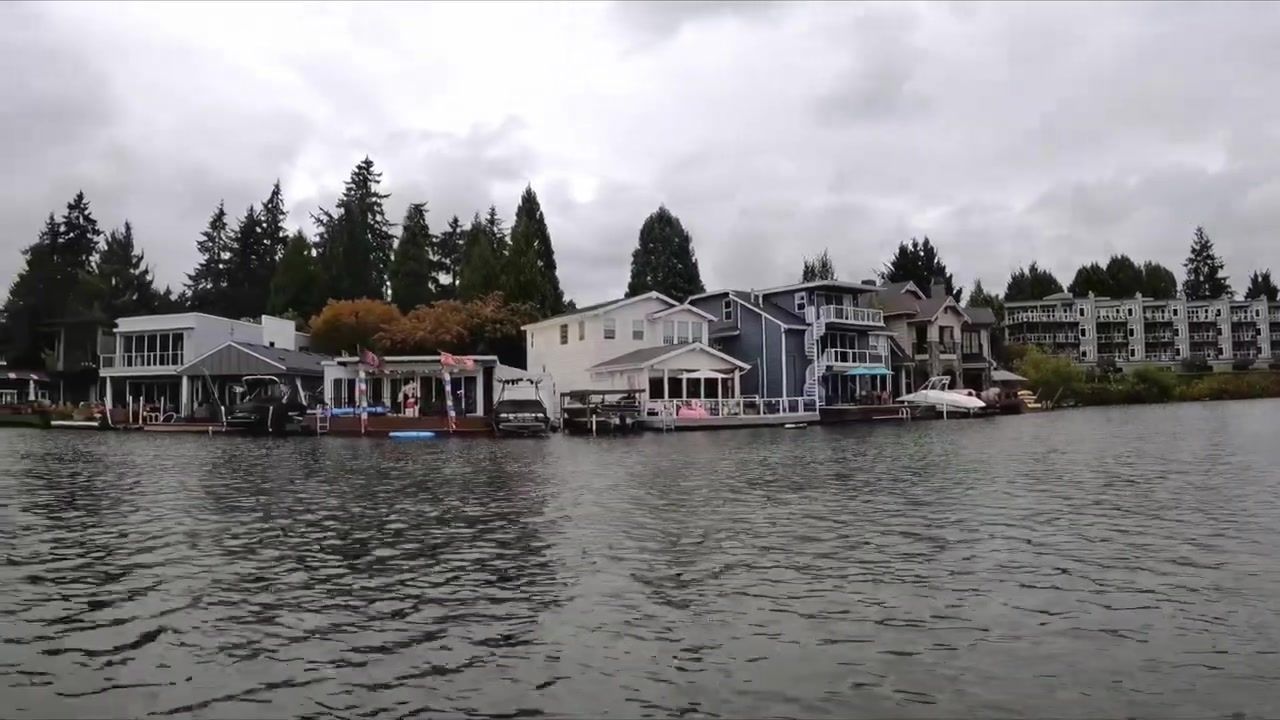
The Evergreen neighborhood is home to the original Lakewood Cabanas. The first one you see is a blue-gray two-story unit with white awnings, built in the International Style. Richard Sundeleef designed these cabanas in 1935 as rental units for the lavish Lakewood development. At the time, they were considered very avant-garde. Strong horizontal lines, flat roofs, and construction on piers over the water were not common in residential design. Nautical elements like gangplanks and anchor lines were staple features of the International Style, and this cabana remains largely intact. Nine other cabanas were built west of this one, but this is the one that survived.

If you are looking at homes in this area, you will notice that some of the original lake cottages have no driveways. That was the scale of development when these were built. Access was by foot or boat. Some of these cottages are still standing, and they give you a sense of what the lake community looked like before the larger estates moved in.

English Arts and Crafts and Tudor Homes

The English Arts and Crafts style shows up repeatedly around the lake. This style began in Britain in the late 1800s, driven by William Morris, who wanted to return to a pre-industrial, handmade society. The movement rejected the excessive decoration of Victorian construction and the overuse of machinery. British Arts and Crafts homes feature references to medieval and Japanese design, with an emphasis on natural materials and craftsmanship.

One example is a home built in 1939 by Richard Sundeleef. It is a designated City of Lake Oswego landmark and is known as the Peerless House, named after its first owners, Kenneth and Viola Peerless. Ken was an entrepreneur, and the home was selected by the American Institute of Architects Board of Chapter as an honorable mention. It was noteworthy for its extremely modern and rare Cubist design, which was unusual for the time.

Another home is the Cone House, a two-story gray house with white trim. Jameson Kirkwood Parker designed this house for Ralph McKenzie Cone in 1933. Charles W. Ertz Company constructed the home. Charles Ertz was a neighbor on North Shore, and Ralph Cone was a prominent Portland attorney who was elected president of the Lake Oswego Corporation in 1944. The Cone House is a good example of how the Arts and Crafts style translated into residential design in this area.

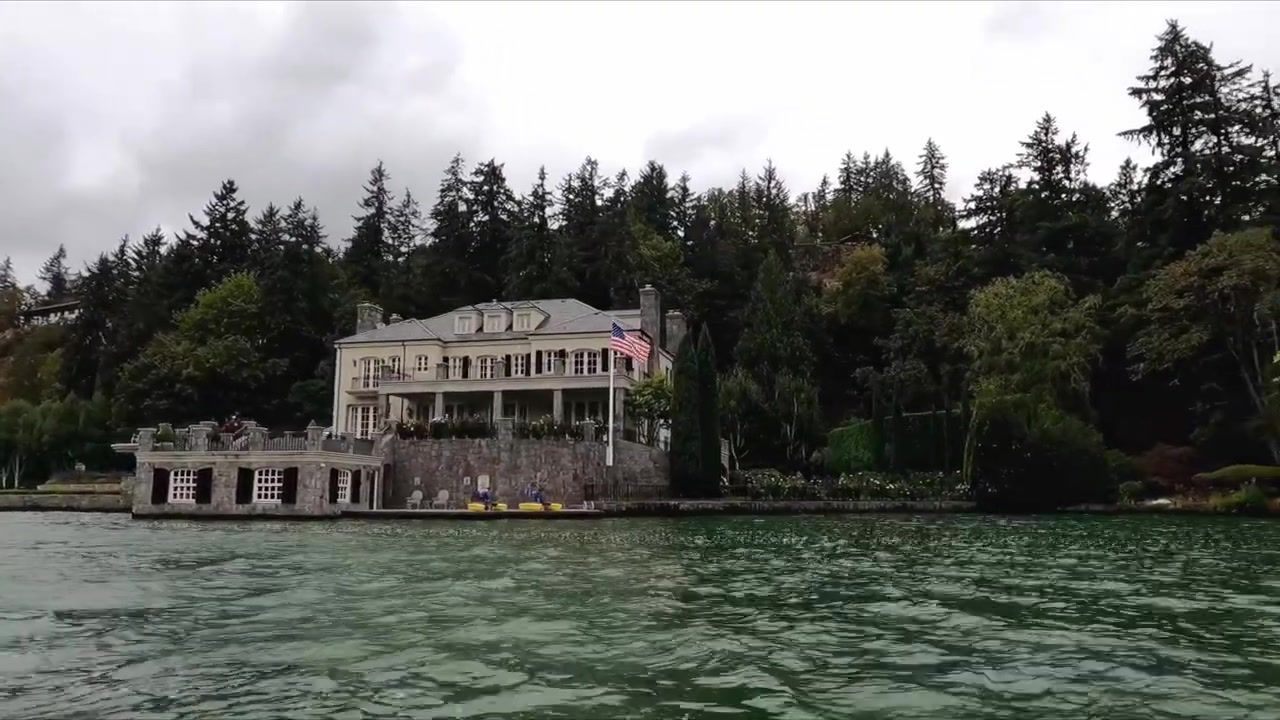
There is also a tan stone mansion that occupies the former site of the Charles Ertz House, which was demolished in 2000. The original house was a 4,600-square-foot Tudor-style structure built in 1928. A 1931 article in the Oregonian described the property as having an old-world bridge of logs and stone supported by Gothic arches with a turreted gateway. The article said that by closing your eyes for a brief instance, you could turn it into a castle drawbridge. The original massive hand-hewn log beams have been replaced with steel to preserve the structure. The property was listed on the National Register of Historic Places, and parts of the original structure were reused for a new boathouse, art studio, and guest house. The eco grass roof blends the building into the landscape, and the trapezoidal windows framed in wood are site-built, not standard manufactured windows.

If you are buying a home that is on the National Register, you need to know that listing does not prevent you from making changes, but it does mean you will face restrictions if you want to alter character-defining features. For example, if you want to redo the windows because they are old single-pane wood-lined units with putty, you may not be allowed to replace them if they are part of the home's story.

Mid-Century Modern and Googie Style

The mid-century modern homes on the lake are a contrast to the Tudor and Arts and Crafts structures. One home has walls of glass, a white gable, and blue panel accents on each side. It is in the Googie style, which is a subset of mid-century modern. The name Googie comes from a coffee shop chain in Los Angeles that embraced this style. The term was originally meant as a pejorative, but it has come to describe buildings with distinctive shapes, bold colors, walls of glass, and futuristic design elements. This style was about looking forward, not back. Some people called it futuristic, while others called it prehistoric because of the exaggerated angles and forms.

Another mid-century modern home is a small brown structure tucked between two larger homes. It features a flat roof and clean lines. Wade Hampton Pipes designed a home in 1954 for his friends John and Elizabeth Bates. This is the Bates House, and it is on the advisory committee on historic preservation. A new owner built a modern addition on the right side of the home, complementing the existing house but not detracting from its original design. This is a good example of how you can add to a historic home without losing its character, but it requires careful planning and approval.

Colonial Revival and Other Styles

There are also Colonial Revival homes around the lake. One architect continued to design Colonial Revival houses long after his contemporaries began favoring more modern aesthetics. He dabbled in regional style and modern architecture, but his clients continued to commission him to design Colonial Revival homes in exclusive Portland neighborhoods. He became so associated with the style that it defined his career.

The Berg House is a Tudor-style home originally owned by Herbert and Cecil Berg. The architect has not been identified, but Herbert had successful executive-level careers in airplanes, autos, and alcohol. The home features beautiful stonework, which is a hallmark of Tudor design.

Lake History and Access

The north side of the lake was originally high rocky bluffs and headland. Over the years, the landscape has been reshaped, and the swim docks, park, and concession area that you see today were created. The settlement of Oswego incorporated as the city of Oswego in 1910, and in 1960, after the annexation of Lake Grove, the city officially changed its name to Lake Oswego.

In 1916, before some of these homes were built, the Lake Grove Anglers Club held casting tournaments here. The president of the organization was determined by who caught the largest bass. A seven-pound, ten-ounce fish elected the very first president. That gives you a sense of what the lake was like before the development took over.

If you are looking at homes on Oswego Lake, you need to understand that access is limited. Some homes have no driveways. Some are tucked behind gates or on private roads. The variety of architecture means that no two homes are alike, but it also means that the rules and restrictions vary. If you are serious about buying here, you need to do your homework on what you can and cannot change.

Conclusion

Oswego Lake is not what you see from Millennium Plaza. The lake is bigger, the homes are more varied, and the history runs deeper than most people realize. From the 1935 Lakewood Cabanas to the mid-century modern Googie homes, this is a neighborhood where architecture tells the story. Some homes are on the National Register of Historic Places. Others have been rebuilt or expanded, but the character remains. If you are thinking about moving to Lake Oswego or buying a home with lake access, you need to see what is actually here.

I help people buy and sell homes around the Portland- Vancouver metropolitan area. If you are considering a move or have questions about what it is like to live in Lake Oswego, call or text 503-925-5645, or schedule a meeting here and I would be happy to walk you through what is available and what you need to know before you make a decision.

FAQ

What architectural styles are found around Oswego Lake?

You will see International Style, English Arts and Crafts, Tudor, Colonial Revival, and mid-century modern Googie. Many homes were built between the 1920s and 1950s, and some are designated historic landmarks. No two homes are alike, and the variety is one of the defining features of the lake.

Are there restrictions on renovating homes on Oswego Lake?

Some homes are on the National Register of Historic Places or are designated City of Lake Oswego landmarks. That means you may face restrictions if you want to alter character-defining features like windows, rooflines, or exterior materials. You should verify current restrictions with the city before buying.

Do all homes on Oswego Lake have direct lake access?

Many homes have direct lake access with boathouses, swim docks, and private waterfront. Some of the original lake cottages have no driveways, and access is limited. If lake access is important to you, you need to verify what comes with the property.

When did Oswego change its name to Lake Oswego?

The settlement of Oswego incorporated as the city of Oswego in 1910. In 1960, after the annexation of Lake Grove, the city officially changed its name to Lake Oswego.

What is the Googie style?

Googie is a subset of mid-century modern architecture. The name comes from a coffee shop chain in Los Angeles that embraced this style. Googie buildings have distinctive shapes, bold colors, walls of glass, and futuristic design elements. The style was originally meant as a pejorative term, but it has come to describe a specific type of mid-century modern design.

Can I see more of the lake if I visit in person?

Access to the lake is limited. Some homes are behind gates or on private roads, and some of the original cottages have no driveways. Millennium Plaza offers a public view, but you will not see the full extent of the lake or the variety of homes from that vantage point.

Oregon Relocation Team

Born and raised in the Portland Metro, we’re passionate about Oregon and its people. From beaches to deserts, mountains to valleys, we love helping others experience the beauty of our state. Ready to move to, from, or within Oregon? Let’s connect.

Moving to Portland Metro and the Oregon Coast

Oregon Relocation Guide

Recent Posts

If you are thinking about moving to Portland and you are researching different neighborhoods and what it's like
By Oregon Relo Team - Seth & Paul • October 11, 2026
Moving to Portland, Oregon? Learn how to spot relocation clickbait, research neighborhoods, compare housing options, and find reliable local insights.

So we We see this every single day, so I've also got a little PSA tip for all
By Oregon Relo Team - Seth & Paul • October 4, 2026
Learn where you can drive on Oregon Coast beaches, including Sand Lake, Florence and Coos Bay, plus permits, flags and driving tips.

Portland Metro Area: The Standoff Between Buyers and Sellers — Started, Buyers, But
By Oregon Relo Team - Seth & Paul • September 25, 2026
Portland's housing market shows conflicting signals with inventory building and sales slowing, yet prices remain steady. Let's breakdown what's happening.

And I think when you look at Astoria, You're looking at one of the biggest towns on the
By Oregon Relo Team - Seth & Paul • September 20, 2026
Explore the most affordable towns on the Oregon Coast and learn what home prices, inventory, housing stock, and trade-offs look like in each community.

Best Portland Suburbs for Relocating to Oregon
By Oregon Relo Team - Seth & Paul • September 13, 2026
A local broker ranks Portland's top 15 suburbs using real moving data and 30+ years of experience. Discover why Lake Oswego isn't number one and which towns punch above their weight.
Oregon Coast Tsunami Risk: What Homebuyers Need to Know
By Oregon Relo Team - Seth & Paul • September 6, 2026
Discover Oregon Coast neighborhoods from Astoria to Brookings outside tsunami inundation zones. Learn about elevation, evacuation routes, and high ground options for coastal safety.
decent access to the city, but you are quite a bit removed at the same time.
By Oregon Relo Team - Seth & Paul • September 6, 2026
Navigating Portland's west side suburbs? Learn why city boundaries, school districts, and unincorporated areas matter when searching for homes in Beaverton, Tigard, and Hillsboro.
Man pondering over aerial neighborhood view with bold text: “WHICH PART OF NE PORTLAND IS THE BEST?”
By Paul Clem • August 31, 2026
Explore the best Northeast Portland neighborhoods, home styles, lifestyle options, affordability, and areas to consider before moving.
“The Layers of Wilsonville” title graphic with a smiling man pointing at the text over a cityscape background
By Seth Marchant • August 25, 2026
Explore the best areas to live in Wilsonville Oregon, from Villebois and Frog Pond to Town Center, Old Town, rural areas, and Charbonneau.

Person thinking over coastal village aerial view with text, “Oregon Coast Villages: Which is best?”
By Paul Clem • August 24, 2026
Explore 8 of the best places to live on the Oregon Coast, from quiet villages to coastal communities near Lincoln City, Tillamook, and Newport.